
Do you like your ash tree?
This is the first question that we ask new customers of Great Western Tree Care that have Ash tree(s) on their property. If their answer is yes, we will explain to them the importance of preventative treatments. Unfortunately, as populations of the insect continue to grow year after year, Ash trees across the state will begin to die if left untreated. When populations get elevated in an area it is 100% fatality of Ash that have not been treated. The insect does not discriminate. It doesn’t matter whether it’s Purple Ash, White Ash, Green Ash, etc. It doesn’t matter whether it’s an old mature tree or a new plant. It simply kills Ash trees.
I’ve been a Certified Arborist for 10 years. Tree care is my passion, it is my life and I truly fear what is going to happen to the beauty of neighborhoods across the front range. There will be a day when you turn down a residential road in your HOA and every Ash tree is either dead or declining because the HOA either couldn’t afford or chose not to treat their Ash populations. As a homeowner, unfortunately you have no control over that, but you do have control over the decision to treat the Ash on your property.
~Chad Szpunar, Owner GWTC
Things to keep in mind:
Not all Ash trees are good candidates for treatment. What makes them unworthy?
Significant structural defects
Small tree, 10" diameter
Near or under power lines
Stress from other pests is substantial
Already infested and has more than 30% canopy decline
Long-term you, as the owner of the tree, needs to consider Cost Vs. Benefit. Investing in treatment options to protect your Ash trees can be costly over time. The treatment need to be applied to the tree(s) every two years indefinitely into the future.
Great Western Tree Care is here to help!
If you have ash trees on your property, our Certified Arborists are available for a free consultation. And if you’re not sure what species you have, you’re not alone—many homeowners enjoy the shade and beauty of their trees without ever knowing exactly what they are.
Background on the Borer
The Emerald Ash Borer (EAB) is a highly destructive invasive insect native to northeast Asia, specifically China, Japan, Korea, and Mongolia. It was unintentionally introduced to North America in the 1990s, likely via solid wood packing material used in shipping. The first confirmed detection of EAB in the United States was in 2002 in Detroit, Michigan, where it was found infesting ash trees in urban areas.
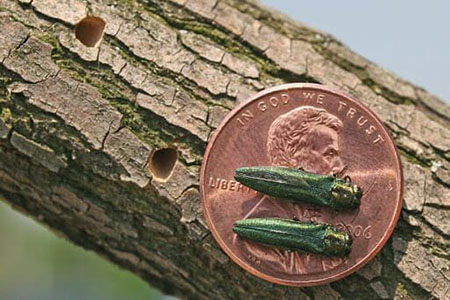
EAB larvae feed on the inner bark of ash trees, disrupting the tree's ability to transport water and nutrients, ultimately causing the tree to decline and die. The adult beetles, which are metallic green in color and about 1/2 inch long, leave distinctive D-shaped exit holes in the bark of infested trees.
Since its arrival in the United States, EAB has caused significant ecological and economic devastation. As of 2021, it has been detected in 35 states and two Canadian provinces, infesting millions of ash trees and causing billions of dollars in damages. The insect has a high reproductive rate and can spread rapidly, with adult beetles capable of dispersing up to 2 miles on their own and up to 75 miles via human-assisted transport, such as on firewood or in nursery stock.
In Colorado, EAB was first detected in 2013 in Boulder County, likely introduced via infested nursery stock. Since then, it has spread to several other counties, including Denver, Adams, and Jefferson, threatening Colorado's estimated 1.3 billion ash trees.
importance of preventing further introductions and managing existing infestations through early detection, tree removal, and biological control.

Great Western Tree Care
Larkspur, CO Location
Mon - Fri: 8a to 5p
9575 Spruce Mountain Rd
Larkspur, CO 80118
(720) 535-8769
Aurora, CO Location
Mon - Fri: 8a to 5p
10730 E Bethany Dr
Aurora, CO 80014
(303) 325-3541