TREE CABLING & BRACING

Across Colorado, aging trees often show their years through hidden decay or stressed limbs, but with the right tree support systems—such as cabling or bracing—many can be made safe again while preserving a cherished tree and protecting your property.

Professional Tree Cabling and Bracing Services in Denver, CO

Great Western Tree Care installs supplemental support systems, cabling, bracing, and guying, that reduce the risk of structural failure in trees with identified defects. Not every tree with a structural weakness needs to be removed. When a tree risk assessment identifies codominant stems, weak branch unions, overextended limbs, or other failure-prone conditions, cabling and bracing systems can reduce risk to acceptable levels while preserving the tree's value to your landscape. Our ISA-Certified Arborists design support systems following ANSI A300 Part 3 standards for Supplemental Support Systems, ensuring every installation is engineered to the specific tree's structural needs. Call (720) 535-8769 to schedule your free consultation.

Types of Tree Support Systems

Dynamic Cabling

Dynamic cable is a non-rigid synthetic fiber which was developed as an alternative to rigid (steel cable) systems. Dynamic systems allow the tree to continue to move and grow naturally, except in the event of high winds or heavy snow where they help support limb failure.

The benefit is, the weak branch union over time will strengthen by creating what’s called “reaction wood” until it becomes strong enough to support itself. Another benefit of dynamic cables vs. steel cables is that you don’t have to drill holes into your tree to install bolts for support.

Bracing

Tree braces are strong metal rods installed through limbs or trunks to reinforce weak branch unions and stabilize areas that have begun to split. By physically tying structural points together, bracing helps redistribute weight and reduce movement in vulnerable sections of the tree.

This technique is especially valuable for trees with multiple leaders—those competing vertical stems that often pull away from each other as they grow. When properly installed, braces can prevent further separation, extend the life of the tree, and protect surrounding property from potential limb failure.

Static Cabling

Though dynamic cables are overall better for the health of your tree as it sometimes isn’t necessary to use the extremely rigidness of static cabling (or steel cable).

Steel cable is best utilized if there are cracked stems already, or if the weight of the limbs being cabled is too heavy to be supported by a dynamic cable, or if the tree is in immediate danger of breakage.

Guying

Guying is most commonly used when planting new trees as part of temporary tree support systems, providing stability while roots establish. Support lines are attached about three-quarters up the trunk and anchored to stakes, reducing excess movement from wind or loose soil. These supports are typically removed within a year once the tree can stand on its own.

Guying mature trees is less common and is generally reserved for preserving historically significant or uniquely valuable specimens that require short-term stabilization within a broader tree support system approach.

Tree Cabling Systems

Static Steel Cable Systems

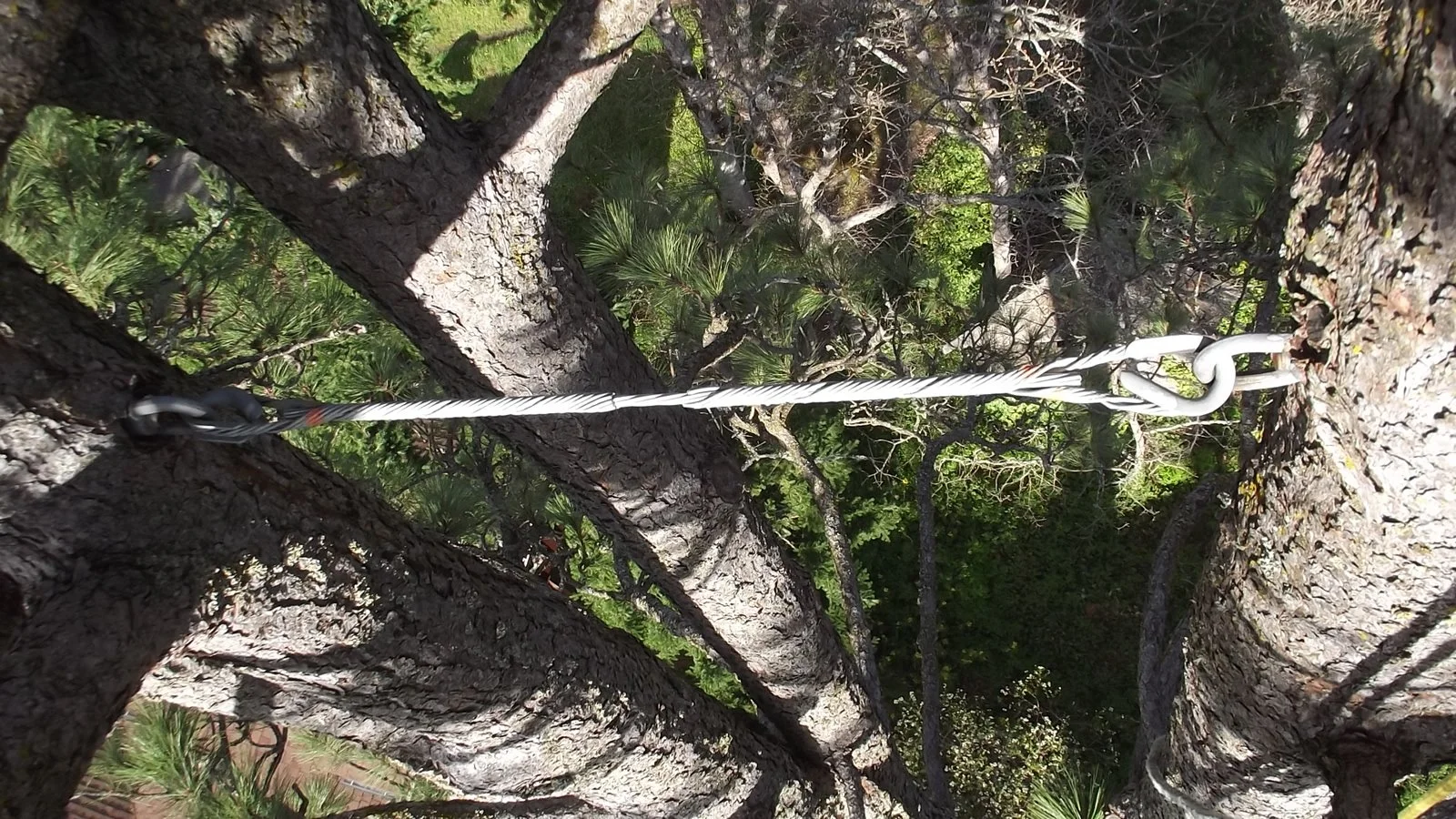
Static cabling uses high-strength steel cable (typically extra-high-strength galvanized steel) installed between codominant stems or major scaffold branches to limit their range of movement relative to each other. Steel cables are attached using through-bolts (J-hooks or eye bolts) installed through the wood at strategic points, typically at two-thirds the distance from the defect to the branch tips. This placement provides maximum mechanical advantage while maintaining enough flexibility for natural sway. Static systems are the industry standard for reducing failure risk in trees with included bark unions, heavy lateral branches, or split-prone codominant stems common in Front Range shade trees including honeylocust, green ash, Siberian elm, and silver maple.

Dynamic Cable Systems

Dynamic cabling uses synthetic rope or webbing materials (such as Cobra, BOA, or similar systems) that allow greater movement than static steel while still limiting extreme displacement that leads to failure. Dynamic systems are installed without hardware penetrating the wood; instead, slings wrap around branches and connect through shock-absorbing synthetic cables. These systems are preferred for younger trees, trees with moderate risk levels, and situations where preserving natural movement is desirable. Dynamic systems require more frequent inspection and replacement (typically every 5–7 years) compared to static steel installations.

Multi-Cable Configurations

Complex canopy structures may require multiple cables installed at different levels and between different branch pairs to address all identified failure points. Our arborists design cable configurations based on the specific defects identified during risk assessment, mapping each cable's anchor points, direction, and tension to create an integrated support system. For trees with three or more codominant stems, common in trees that were topped years ago and developed multiple competing leaders, triangulated cable configurations distribute forces more effectively than single-cable installations.

Tree Bracing Systems

Through-Rod Bracing

Brace rods, threaded steel rods installed through the trunk or branch union, provide rigid support for splits, cracks, and weak unions that cables alone cannot stabilize. Brace rods are most effective when installed through codominant stem unions where included bark has created a seam that may split under load. The rod passes through both stems and is secured with washers and nuts on each side, physically preventing the union from separating. Bracing is often combined with cabling above the union to create a comprehensive support system.

When Bracing Is Required

Bracing is prescribed when structural defects involve active splitting or separation at the point of attachment. Cracks extending through a union, visible included bark seams under tension, and partially split codominant stems require the rigid reinforcement that only bracing provides. Our TRAQ-qualified arborists evaluate whether the defect is stable enough for cable-only support or requires the addition of bracing to prevent progressive failure. Trees along the Front Range face particular splitting risk during heavy wet spring snowstorms in April and May when saturated canopies load weak unions beyond their capacity.

Temporary and Permanent Tree Guying Systems

Guying uses ground anchors and tensioned cables or straps to stabilize trees with compromised root plates or excessive lean. Newly planted large-caliper trees often require temporary guying during their establishment period until root systems develop adequate anchorage. Permanent guying may be prescribed for mature trees that have developed lean due to root loss from construction, soil erosion, or progressive root decay, particularly on properties in Castle Pines and Roxborough Park where sloped terrain and shallow soils increase lean risk.

Unique To Colorado

In Colorado, cabling and bracing systems can help stabilize weak or split trees—protecting against heavy snow, wind, and drought stress that can lead to costly failures.

tree cabling and bracing

How Much Does Tree Cabling and Bracing Cost in Denver, CO?

Cabling and bracing costs depend on the number of cables or braces required, tree size, access, and system type. Here are general ranges:

Single Static Steel Cable Installation: $300–$800 per cable including hardware, installation, and post-installation inspection

Single Dynamic Cable Installation: $250–$600 per cable depending on system type and tree access

Brace Rod Installation: $200–$500 per rod including hardware and installation

Combined Cable and Brace System (single tree): $500–$1,500+ depending on the number of cables and rods required

Multi-Tree Support Program: Per-tree pricing decreases for properties with multiple trees requiring support systems

Inspection and Maintenance (existing systems): $75–$200 per tree for annual hardware inspection and cable tension verification

Cost factors specific to the Denver metro area include:

  • Properties in Highlands Ranch and Lone Tree with mature shade trees near homes frequently require cabling to manage codominant stem risk
  • Trees previously topped in Aurora, Centennial, and Englewood often develop multiple weak leaders requiring complex multi-cable configurations
  • Tall trees requiring extensive climbing or aerial lift access increase installation time and cost
  • Combining cabling with crown thinning or reduction pruning reduces overall wind loading and may decrease the number of cables needed

Tree Cabling and Bracing by Property Type

Residential Properties with Mature Trees Near Structures

Mature shade trees that have provided decades of canopy coverage represent significant aesthetic and monetary value. When these trees develop structural defects, removal eliminates canopy that would take 20–40 years to replace. Cabling and bracing preserve the tree's functional value while mitigating the specific risk identified during assessment. Properties in Parker, Castle Rock, and Larkspur with large specimen trees benefit from support systems as a cost-effective alternative to removal and replacement.

Trees Over Structures and High-Use Areas

Trees positioned directly over homes, decks, patios, driveways, and play areas present the highest consequences of failure. When assessment identifies structural defects in these trees, support systems combined with targeted pruning to reduce end-weight can lower risk to levels that avoid removal while protecting the areas below.

Previously Topped Trees

Trees that were topped years or decades ago frequently develop multiple weakly attached leaders that grow rapidly and become increasingly heavy. These regrowth structures are more failure-prone than the original branches the topping removed. Cabling these new leaders together limits their independent movement and reduces the likelihood of splitting during wind or snow events. Combined with restoration pruning to select dominant leaders and remove competing sprouts, support systems help manage the long-term structural consequences of past topping.

FAQs About Tree Cabling and Bracing in Denver, CO

How long do tree cables last?

Will cabling damage my tree?

Can cabling prevent a tree from falling in a storm?

How do I know if my tree needs cabling or removal?

Do I need to inspect tree cables after installation?

Can you cable a tree that has already started to split?

Why Great Western Tree Care for Tree Cabling and Bracing

3 ISA-Certified Arborists on Staff: Our arborists design support systems based on tree biology, species-specific wood properties, and structural mechanics, ensuring every installation addresses the identified defect with the appropriate system type and placement.

2 TRAQ-Certified Professionals on Staff: Tree Risk Assessment Qualification training directly informs cabling and bracing decisions. Our TRAQ-qualified arborists evaluate which defects can be effectively mitigated with support systems and which require alternative interventions.

3 Colorado Department of Agriculture Plant Health Care Qualified Supervisors: Understanding tree health conditions, including disease and decay progression, is essential for determining whether a tree is a viable candidate for support system installation or has deteriorated beyond the point where hardware can provide meaningful risk reduction.

Family-Owned Since 2018: Headquartered in Larkspur, Colorado, we design and install support systems across Douglas County and Arapahoe County with the local knowledge that informs wind loading assumptions, snow load expectations, and species-specific failure patterns.

1 Certified Treecare Safety Professional (CTSP): Ensures all aerial installation work meets ANSI Z133.1 safety standards for climbing, rigging, and hardware installation in elevated positions.

Our Tree Cabling and Bracing Process

Step 1: Risk Assessment and System Design: We evaluate the tree's structural defects, target zones, and overall health to determine whether supplemental support is appropriate and which system type best addresses the identified risk.

Step 2: Installation Plan and Estimate: We design the specific cable and brace configuration, identify anchor points, select hardware specifications, and provide a detailed estimate covering materials, installation, and post-installation inspection.

Step 3: Scheduling and Coordination: We schedule installation during appropriate conditions and coordinate with any pruning work that should precede or accompany support system installation.

Step 4: Installation: Our crew installs cables, brace rods, and/or guying systems according to ANSI A300 Part 3 standards. All hardware is inspected during installation for proper placement, tension, and load distribution.

Step 5: Inspection and Monitoring Schedule: We conduct a post-installation inspection to verify system performance, document the installation with photos and specifications, and establish an annual inspection schedule to monitor hardware condition, cable tension, and tree growth response.

Additional Tree Care Services

Greater Denver Metro Service Areas

Schedule Your Tree Cabling and Bracing Consultation

Preserving a structurally compromised tree is often more practical and cost-effective than removing it, when the right support system is installed by qualified professionals. Great Western Tree Care designs and installs supplemental support systems that protect your property while maintaining the trees you value.

tree support systems