
TREE PRUNING & TRIMMING
Thoughtful, high-quality tree pruning by ISA certified arborists that keep your trees healthy and your property looking its best—done right the first time.

Dependable Tree Pruning and Tree Trimming Services in Denver, CO
Great Western Tree Care provides professional tree pruning and trimming services for residential properties across the Denver metro area. Proper pruning is the single most impactful maintenance practice for tree health, structural integrity, and safety, yet improper cuts cause more long-term damage than no pruning at all. Our ISA-Certified Arborists follow ANSI A300 pruning standards on every job, making species-appropriate cuts that promote healthy wound closure, maintain structural balance, and preserve the natural form that makes each tree valuable to your landscape. Whether your property needs crown thinning for storm damage prevention, deadwood removal for safety, or structural pruning on young trees to prevent future problems, we deliver results backed by arboricultural science. Call (720) 535-8769 to schedule your free pruning consultation.
Professional Tree Trimming
Crown Thinning
Crown thinning selectively removes interior branches to reduce canopy density without altering the tree's overall shape or size. This technique increases light penetration and air circulation within the canopy, reducing conditions that promote fungal diseases like cytospora canker on spruce and fireblight on ornamental species. Thinning also reduces wind resistance, which is critical along the Front Range where sustained winds exceed 40 mph during spring storm events and microbursts can generate gusts over 80 mph. We limit removal to 15–25% of the live canopy per pruning cycle following ISA guidelines, preventing stress response that triggers excessive water sprout production.
Crown Raising and Clearance Pruning
Crown raising removes lower branches to provide vertical clearance over sidewalks, driveways, structures, and sight lines. Denver municipal code and most HOA guidelines require minimum clearance heights, typically 8 feet over sidewalks and 14 feet over streets. We make proper branch collar cuts that promote compartmentalization rather than flush cuts or stub cuts that create decay entry points. For mature trees with heavy lower limbs, we use reduction cuts rather than removal to maintain branch taper and structural integrity.
Crown Reduction
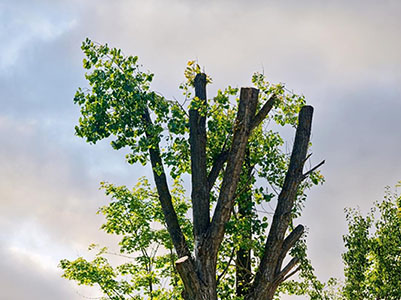
Crown reduction decreases the overall height or spread of a tree using reduction cuts that shorten branches back to lateral limbs large enough to assume the terminal role, typically at least one-third the diameter of the removed portion. This technique maintains the tree's natural form while reducing size, unlike topping, which we never perform. Topping creates weak regrowth attachments that are more dangerous than the original branches. Crown reduction is commonly needed when trees have outgrown their planting space or are encroaching on structures, power lines, or neighboring properties in communities like Centennial, Littleton, and Englewood where lot sizes limit available growing space.
Deadwood and Hazard Limb Removal
Dead, dying, and structurally compromised branches pose direct safety risks to people, structures, and vehicles below the canopy. Denver's combination of heavy spring snowstorms, summer thunderstorms with hail and high winds, and freeze-thaw cycles throughout winter creates persistent branch failure conditions. We remove dead branches, broken hangers, and branches with included bark unions or excessive end-weight that increase failure likelihood. For trees with multiple structural concerns, we coordinate pruning with tree risk assessment and cabling systems to address the full range of identified hazards.
Tree Pruning Techniques
Structural Pruning for Young Trees
The most cost-effective pruning investment is structural training on young trees during their first 5–10 years after planting. Structural pruning establishes a dominant central leader, eliminates competing leaders that develop weak V-shaped unions, spaces scaffold branches for balanced weight distribution, and removes branches with included bark that will become failure points as the tree matures. Correcting structural defects on a young tree with a hand saw costs a fraction of what it takes to cable, brace, or remove a mature tree that developed those same defects unchecked.
Vista Pruning
Vista pruning selectively thins or removes branches to restore views blocked by tree growth without dramatically altering the tree's form or health. This technique is particularly valued on properties in Castle Pines, Roxborough Park, and Castle Rock where mountain and foothill views are a significant component of property value. We create targeted sight windows through the canopy while maintaining enough foliage density for tree health and privacy.
Restoration Pruning
Trees damaged by storms, improper past pruning (including topping), or neglect require specialized restoration pruning to rebuild structural integrity over multiple pruning cycles. We select the strongest remaining shoots to develop as replacement leaders, remove competing sprouts, and gradually reshape the canopy over 2–3 pruning seasons. Attempting to restore a previously topped tree in a single visit removes too much foliage and compounds the original damage.
Seasonal Pruning Considerations
Pruning timing affects tree response and pest vulnerability. We schedule most deciduous tree pruning during late winter dormancy (February–March) when branch structure is visible and wound closure begins immediately with spring growth. Oak pruning is restricted to dormant season to avoid oak wilt transmission risk. Elm pruning is scheduled outside the April–September beetle flight season to reduce Dutch elm disease exposure. Spring-flowering ornamental trees are pruned immediately after bloom to avoid removing next year's flower buds. Deadwood removal and hazard pruning can be performed any time conditions warrant.
Unique To Colorado
In Colorado, proper tree pruning and tree trimming require precise timing and technique—harsh winters, dry conditions, and rapid weather swings mean the wrong cut at the wrong time can stress, weaken, or even damage your trees.
How Much Does Tree Pruning Cost in Denver, CO?
Tree pruning costs depend on tree size, species, condition, access, and the scope of work required. Here are general ranges for Denver metro properties:
Small Tree Pruning (under 25 feet): $150–$400 per tree for structural pruning, deadwood removal, or crown shaping
Medium Tree Pruning (25–50 feet): $300–$800 per tree for crown thinning, raising, or moderate reduction work
Large Tree Pruning (50–80+ feet): $600–$2,000+ per tree depending on canopy spread, access, and scope of work requiring aerial equipment
Multi-Tree Property Program: Per-tree pricing decreases for properties with multiple trees pruned during the same visit
Emergency Hazard Limb Removal: $200–$1,000+ depending on limb size, location, and urgency
Cost factors specific to the Denver metro area include:
- Properties in Highlands Ranch and Parker with large lot sizes and mature tree inventories benefit from annual pruning programs
- Trees overhanging structures, fences, or power lines require additional safety rigging and crew time
- Steep terrain on properties in Larkspur and Roxborough Park may affect equipment access
- HOA communities may require specific pruning standards or tree preservation guidelines
Tree Pruning by Property Type
Residential Properties with Mature Shade Trees
Established neighborhoods across Aurora, Centennial, and Littleton feature mature shade trees, often 40–60+ feet tall, that require periodic crown maintenance to manage deadwood accumulation, maintain clearances, and reduce storm damage risk. Our arborists assess each tree's structural condition and prioritize pruning objectives based on safety concerns and health needs.
Properties with Young Developing Trees
New plantings and immature trees in recently developed communities benefit most from early structural pruning that prevents defects from becoming permanent. Investing in structural training during the first decade produces trees with strong branch architecture, balanced canopy weight distribution, and reduced long-term maintenance costs.
Properties with Conifers and Evergreens
Ponderosa pine, Colorado blue spruce, and Douglas fir require species-specific pruning approaches that differ from deciduous tree techniques. We remove dead lower branches (candle pruning is not required on most mature conifers), thin interior deadwood that harbors disease pathogens, and manage canopy density to improve air circulation. Spruce trees with cytospora canker require targeted removal of infected branches using sterilized tools.
FAQs About Tree Pruning in Denver, CO
Why Great Western Tree Care for Tree Pruning
3 ISA-Certified Arborists on Staff: Our arborists hold credentials from the International Society of Arboriculture reflecting verified expertise in tree biology, pruning science, and structural assessment. Every pruning prescription is written by an arborist, not a general laborer estimating from the ground.
3 Colorado Department of Agriculture Plant Health Care Qualified Supervisors: State-recognized qualification in plant health diagnostics ensures pruning decisions account for disease management, pest control, and overall tree vigor.
Family-Owned Since 2018: Headquartered in Larkspur, Colorado, we know the species mix, common structural issues, and weather-related damage patterns across every community in our service area.
2 TRAQ-Certified Professionals: Tree Risk Assessment Qualification training directly informs pruning priorities, identifying which branches, attachment types, and structural defects present the greatest failure risk.
1 Certified Treecare Safety Professional (CTSP): Ensures all aerial pruning operations meet ANSI Z133.1 safety standards for arboricultural operations, including proper climbing techniques, rigging practices, and worksite management.
Our Tree Pruning Process
Step 1: On-Site Consultation and Tree Assessment: We evaluate each tree's species, age, structural condition, health status, and relationship to surrounding targets (structures, walkways, utilities). We identify specific pruning objectives and priorities.
Step 2: Pruning Prescription and Estimate: Based on the assessment, we write a pruning prescription specifying the type of pruning (thinning, raising, reduction, deadwood removal), target branches, and expected outcomes. You receive a detailed estimate before any work begins.
Step 3: Scheduling and Seasonal Timing: We schedule pruning during the optimal seasonal window for each tree species, coordinating with any pest management or fertilization treatments that should precede or follow pruning.
Step 4: Pruning Execution: Our crew performs all cuts following ANSI A300 standards using species-appropriate techniques. We use proper branch collar cuts, avoid flush cuts and stub cuts, and limit removal to prescribed percentages of live canopy. All debris is chipped or removed from the site.
Step 5: Post-Pruning Inspection and Follow-Up: We conduct a ground-level review of completed work, document pruning performed on each tree, and recommend timing for the next pruning cycle based on species growth rate and site conditions.
Additional Tree Care Services
- Great Western Tree Care offers comprehensive tree and plant health care services that complement our pruning programs:
Greater Denver Metro Service Areas
- Our tree pruning crews serve residential properties throughout Douglas County and Arapahoe County from our Larkspur, Colorado headquarters:
Schedule Your Tree Pruning Consultation
Properly maintained trees are safer, healthier, and more valuable. Great Western Tree Care provides ISA-Certified Arborist pruning services that follow industry standards and protect your trees' long-term structural integrity.
Call (720) 535-8769 to schedule your free on-site pruning consultation, or use the form below to request an estimate.

Great Western Tree Care
Larkspur, CO Location
Mon - Fri: 8a to 5p
9575 Spruce Mountain Rd
Larkspur, CO 80118
(720) 535-8769
Aurora, CO Location
Mon - Fri: 8a to 5p
10730 E Bethany Dr
Aurora, CO 80014
(303) 325-3541