
TREE REMOVAL
When a tree poses risk or decline sets in, professional tree removal ensures safety, protects your property, and prepares your yard for what’s next.

Safe and Reliable Tree Removal Services in Denver, CO
Great Western Tree Care provides professional tree removal services for residential properties across the Denver metro area. Tree removal is a last-resort measure; we always evaluate whether pruning, cabling, or pest treatment can preserve the tree before recommending removal. When removal is necessary, due to structural failure risk, advanced disease or pest damage, storm damage beyond recovery, or construction conflicts, our ISA-Certified Arborists and TRAQ-qualified professionals execute removals safely using techniques matched to the tree's size, location, and surrounding targets. Call (720) 535-8769 to schedule your free tree removal assessment.
Our Tree Removal Process
Expert Evaluation
Every removal starts with a certified arborist’s risk assessment to determine the safest approach.
Specialized Equipment
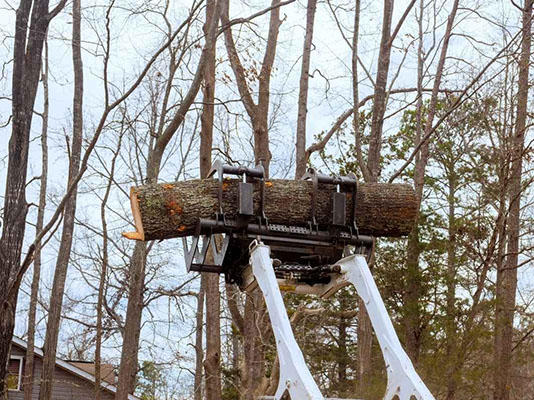
We utilize advanced equipment—including cranes and advanced rigging techniques—when necessary for complex or large-scale removals.
Stump Grinding & Cleanup
After removal, we can grind the stump and leave your property clean and ready for replanting or landscaping.
Safety & Insurance
Our crews follow ANSI Z133.3 safety standards, are fully insured, and guarantee protection for your property.
Safe Tree Removal Process
Hazard Assessment Before Removal
Every tree removal begins with a thorough site assessment. Our TRAQ-certified arborists evaluate the tree's lean direction, structural defects, deadwood distribution, root plate condition, and proximity to structures, power lines, fences, and neighboring properties. We identify target zones, areas where workers, equipment, and bystanders must be excluded during felling or sectional dismantling. This assessment determines the removal method, equipment requirements, and rigging plan for each tree.
Sectional Dismantling
Most residential tree removals in the Denver metro area require sectional dismantling rather than directional felling because of proximity to structures, utilities, and property boundaries. Our climbers ascend the tree, remove the canopy in manageable sections, and lower branches using controlled rigging techniques. Larger limbs are rigged with lowering lines, blocks, and friction devices that control descent speed and direction, preventing impact damage to landscaping, structures, and underground irrigation systems below.
Directional Felling
When adequate clear space exists, common on larger lots in Parker, Castle Rock, and Larkspur, directional felling drops the entire tree in a controlled direction using precision notch-and-back-cut techniques. We calculate hinge dimensions based on tree diameter, lean, and wind conditions to ensure the tree falls precisely within the designated drop zone. This method is faster and more cost-effective than sectional dismantling when site conditions allow.
Crane-Assisted Removal
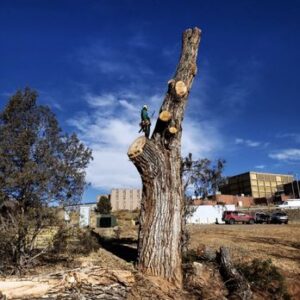
Trees that cannot be safely climbed, due to severe structural compromise, advanced decay, storm damage, or inaccessible canopy, may require crane-assisted removal. A crane operator lifts cut sections directly from the canopy while ground crews process debris. Crane removal is also the most efficient method for very large trees in tight residential settings where sectional rigging would require extended work hours and increased exposure time for climbing arborists.
Emergency Tree Removal
Storm Damage Response
Denver's spring and summer storm season brings heavy wet snow, microbursts, hail, and straight-line winds that cause catastrophic tree failures. Split trunks, uprooted root plates, broken canopies lodged in power lines, and trees fallen onto structures require immediate professional response. Our emergency removal crews mobilize quickly to secure damaged trees, clear access for emergency vehicles, and remove hazardous material from occupied structures.
Hazard Tree Emergency Assessment
Not every storm-damaged tree requires immediate removal. Our TRAQ-qualified arborists assess damaged trees on-site to determine whether the tree can be saved through emergency pruning and cabling, or whether removal is the only safe option. This assessment prevents unnecessary removal of recoverable trees while ensuring genuinely hazardous trees are addressed immediately.
When Is Emergency Removal Necessary?
Emergency removal is warranted when a tree or major limb has failed and is resting on a structure, blocking a roadway or driveway, contacting utility lines, or leaning in a direction that threatens imminent secondary failure. We also respond to trees that have sustained root plate uplift, visible soil heaving on the side opposite the lean, indicating the tree has lost its anchor and full failure is imminent.
Unique To Colorado
Tree removal in Colorado requires careful planning and expertise—rocky soils, tight spaces, and unpredictable weather make safe, efficient removal far more complex than it looks.
How Much Does Tree Removal Cost in Denver, CO?
Tree removal costs depend on tree size, species, condition, location, access, and the complexity of the removal operation. Here are general ranges for Denver metro properties:
Small Tree Removal (under 25 feet): $300–$800 including debris removal and cleanup
Medium Tree Removal (25–50 feet): $800–$2,000 depending on canopy spread, proximity to structures, and access
Large Tree Removal (50–80+ feet): $2,000–$5,000+ depending on trunk diameter, rigging requirements, and site complexity
Very Large or Hazardous Tree Removal: $5,000–$10,000+ for trees requiring crane assistance, extensive rigging, or work near utility lines
Emergency Storm Damage Removal: Pricing varies based on urgency, scope, and site conditions; we provide on-site estimates before beginning work
Stump Grinding (add-on): $100–$400 per stump depending on diameter; see our stump grinding service for details
Cost factors specific to the Denver metro area include:
- Properties in Highlands Ranch and Lone Tree with homes close to property lines require more careful rigging techniques
- Steep terrain in Roxborough Park and Castle Pines can affect equipment access and increase labor requirements
- Trees near overhead utility lines may require utility company coordination before removal can proceed
- Permit requirements vary by municipality; some communities require permits for removing trees above specific diameter thresholds
Tree Removal by Property Type
Residential Properties with Limited Access
Compact residential lots in Centennial, Englewood, and Aurora present removal challenges when trees are surrounded by structures, fences, and neighboring properties with minimal clearance. Sectional dismantling with controlled rigging is the standard approach, removing the tree piece by piece from the top down while protecting everything below.
Properties with Large Mature Trees
Larger properties in Parker, Castle Rock, and Larkspur may feature 80–100+ foot cottonwoods, ponderosa pines, or blue spruce that have reached the end of their productive lifespan or sustained irreparable damage. These trees require heavy rigging, potentially crane assistance, and experienced crews capable of managing the forces involved in lowering multi-ton trunk sections.
Properties Replacing Trees After Pest Damage
Ash trees killed by emerald ash borer, spruce trees declined from chronic cytospora canker, and pines killed by bark beetle infestations represent the most common removal-and-replace scenarios across the Denver metro area. We coordinate removal, site restoration, and replacement planting as a single project to minimize disruption and get new trees established quickly.
FAQs About Tree Removal in Denver, CO
Why Great Western Tree Care for Tree Removal
3 ISA-Certified Arborists on Staff: Our arborists assess every tree before recommending removal, ensuring trees that can be preserved through alternative treatments are not removed unnecessarily. When removal is the right decision, ISA-level expertise ensures the operation is planned and executed safely.
3 Colorado Department of Agriculture Plant Health Care Qualified Supervisors: State-recognized credentials in plant health diagnostics confirm whether tree decline is treatable or terminal, informing the treatment-versus-removal decision with professional accuracy.
Family-Owned Since 2018: Headquartered in Larkspur, Colorado, we operate throughout Douglas County and Arapahoe County with the local knowledge and accountability that comes from being part of the communities we serve.
2 TRAQ-Certified Professionals: Tree Risk Assessment Qualification is the industry-standard credential for evaluating whether a tree poses an unacceptable risk that warrants removal. Our TRAQ-qualified arborists provide documented risk assessments that support removal decisions.
1 Certified Treecare Safety Professional (CTSP): Ensures all removal operations comply with ANSI Z133.1 safety standards, including proper felling techniques, rigging practices, equipment operation, and worksite management.
Our Tree Removal Process
Step 1: On-Site Assessment and Removal Planning: We evaluate the tree's condition, structural integrity, lean, target zones, and site constraints. We determine the appropriate removal method and equipment requirements.
Step 2: Estimate and Scope Confirmation: We provide a detailed estimate covering removal, debris processing, stump grinding (if requested), and site cleanup. We discuss timeline, access requirements, and any coordination needed with utility companies or municipal permits.
Step 3: Scheduling and Site Preparation: We schedule removal during appropriate weather conditions, coordinate equipment staging, and establish work zones with exclusion barriers as needed for safety.
Step 4: Tree Removal Execution: Our crew removes the tree using the planned method, sectional dismantling, directional felling, or crane-assisted removal. All wood is processed on-site (chipped or cut into manageable sections) and debris is removed unless the property owner requests logs or chips to remain.
Step 5: Site Cleanup and Restoration: We remove all debris, rake and clean the work area, and grind the stump if included in the scope. For properties planning replacement planting, we prepare the site for new tree installation.
Additional Tree Care Services
- Great Western Tree Care offers comprehensive tree care services, including alternatives to removal when trees can be preserved:
Greater Denver Metro Service Areas
- Our tree removal crews serve residential properties throughout Douglas County and Arapahoe County from our Larkspur, Colorado headquarters:
Schedule Your Tree Removal Consultation
If you have a tree that may need to be removed, let our ISA-Certified Arborists evaluate it first. We provide honest assessments, recommending removal only when it is the safest option for your property and the tree cannot be preserved through alternative treatments.
Call (720) 535-8769 to schedule your free on-site assessment, or use the form below to request an estimate.

Great Western Tree Care
Larkspur, CO Location
Mon - Fri: 8a to 5p
9575 Spruce Mountain Rd
Larkspur, CO 80118
(720) 535-8769
Aurora, CO Location
Mon - Fri: 8a to 5p
10730 E Bethany Dr
Aurora, CO 80014
(303) 325-3541