
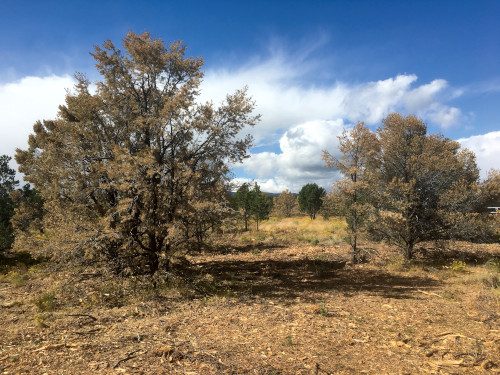
Colorado trees are built to handle a lot: intense sun, wind, temperature swings and relatively dry conditions. But that doesn’t mean landscape trees can thrive indefinitely without adequate moisture.
By late summer, extended dry periods can begin to show up in the canopy, especially along the Front Range where urban and suburban trees are growing in landscapes very different from Colorado’s native forests.
And one of the biggest mistakes homeowners make is waiting until a tree looks severely stressed before responding.
Drought stress often begins below ground long before the symptoms become obvious above it.
Don’t Assume a Mature Tree Can Take Care of Itself
It’s easy to look at a 30-year-old spruce, pine, maple or ash and assume its established root system can find enough water on its own.
Sometimes it can.
During prolonged dry conditions, that assumption becomes increasingly risky.
Landscape trees compete with turf, shrubs and surrounding vegetation for available soil moisture. Irrigation systems designed primarily for lawns may keep the grass green without delivering enough water deeply or broadly enough for a mature tree.
What drought stress can lead to
- Reduced growth
- Premature leaf drop
- Leaf scorch or browning
- Thinning canopy
- Fine-root mortality
- Branch dieback
- Increased vulnerability to insects and disease
- Long-term decline that may not become obvious until a later season
The goal isn’t simply more water.
It’s getting the right amount of water to the right place.
Water the Root Zone, Not the Trunk
If you remember one thing about watering a mature tree, make it this:
The trunk isn’t where most of the water needs to go.
A tree’s absorbing roots extend outward through the soil, with many located beneath and beyond the canopy.
Putting a hose directly against the trunk for 20 minutes may feel productive, but it can leave much of the active root system dry.
Better approach
Apply water slowly across a broad area beneath the tree’s canopy, extending toward the drip line and, when practical, beyond it.
Good options include:
- Soaker hoses
- Drip irrigation
- A hose running at a slow rate and moved periodically
- Soft-spray watering across multiple points in the root zone
Avoid blasting the soil with water faster than it can absorb it.
Water slowly and deeply so moisture reaches the critical root zone rather than simply wetting the surface.
How Much Water Does a Tree Actually Need?
There isn’t one perfect watering schedule for every Front Range property.
Tree size, species, soil, slope, exposure, irrigation, temperature and recent rainfall all matter.
But there is a useful starting point.
A practical rule of thumb
Approximately 10 gallons of water per inch of trunk diameter can provide a useful starting point when determining how much supplemental water a tree may need.
That means a tree with a 4-inch trunk may need roughly 40 gallons during a watering cycle—not the few gallons it receives from briefly running a hose near the trunk.
Don’t turn the guideline into autopilot
Forty gallons isn’t automatically correct because the math says forty gallons.
Check the soil.
If it’s already adequately moist, adding more water can create a different set of problems.
If it’s bone dry several inches below the surface, your normal irrigation schedule may not be reaching the tree effectively.
Water based on conditions, not just the calendar.
Your Lawn Can Be Misleading
A green lawn doesn’t necessarily mean your trees are receiving enough water.
Most turf irrigation is designed to wet relatively shallow soil frequently.
Trees depend on moisture distributed through a much larger root zone.
The opposite can also tell you something.
If the lawn surrounding a tree is dry and dormant and the property hasn’t received meaningful precipitation, there’s a good chance the tree’s root zone is dry too.
Pay particular attention to trees that are
- Outside normal irrigation zones
- Surrounded by hardscape
- Growing on slopes
- Exposed to intense afternoon sun
- Surrounded by competing turf
- Recently planted
- Already dealing with insects or disease
- Showing signs of canopy stress
These trees may need more attention during extended dry periods.
Newly Planted Trees Need Different Attention
A mature tree and a tree planted last year should not be watered the same way.
Newly planted trees have much smaller established root systems and therefore much less ability to seek moisture beyond the original planting area.
For young trees
Monitor soil moisture frequently.
Don’t allow the root ball to repeatedly dry out completely.
But don’t keep it constantly saturated either.
The objective is consistent moisture with adequate drainage.
A young tree can suffer from too much water just as surely as too little.
Mulch Is One of the Simplest Ways to Protect Soil Moisture
A proper mulch ring can reduce evaporation, moderate soil temperature and reduce competition from turf.
But more mulch isn’t necessarily better.
Do
- Create a broad mulch area where practical
- Maintain a moderate, even depth
- Keep mulch away from direct contact with the trunk
- Expand the mulch ring as the tree grows
Don’t
- Pile mulch against the trunk
- Create a “mulch volcano”
- Bury the root flare
- Assume mulch replaces watering
During dry conditions, mulch helps the water you apply remain available in the soil longer.
Know the Signs of Drought Stress
Some symptoms are obvious.
Others are easy to dismiss.
Watch for
- Wilting or curling leaves
- Brown or scorched leaf margins
- Premature fall color
- Early leaf drop
- Sparse foliage
- Needle browning
- Reduced new growth
- Dead twigs or branch tips
- Progressive canopy thinning
One symptom by itself doesn’t automatically mean drought is the cause.
Pest pressure, disease, root damage, nutrient problems and irrigation issues can produce similar symptoms.
That’s why diagnosis matters.
Don’t Fertilize Your Way Out of a Water Problem
A stressed tree doesn’t necessarily need fertilizer.
If inadequate moisture is the underlying problem, pushing additional growth can be counterproductive.
Correct the environmental stress first.
That means understanding:
- Soil moisture
- Irrigation coverage
- Root-zone conditions
- Tree species
- Existing pest or disease pressure
- Overall tree vigor
Tree care should start with diagnosis rather than automatically applying a treatment.
Drought Stress and Pest Problems Often Go Together
This is one of the more important reasons to take prolonged dryness seriously.
A tree using its resources to cope with inadequate moisture has less capacity to respond to additional stress.
That doesn’t mean drought automatically causes a pest infestation.
It means tree health is cumulative.
Heat + inadequate moisture + poor soil + existing damage + pest pressure can become a much bigger problem than any one factor alone.
Don’t Stop Paying Attention After the First Rain
A summer thunderstorm can be dramatic without delivering enough moisture to meaningfully recharge dry soil around a mature tree.
Likewise, rainfall in one Front Range neighborhood can be completely different from rainfall a few miles away.
Instead of assuming the problem is solved because it rained:
Check the soil
After rainfall, inspect moisture several inches below the surface.
If only the top layer is damp, the deeper root zone may still need supplemental water.
Watch the weather pattern
One storm doesn’t necessarily erase weeks of moisture deficit.
Adjust irrigation
If meaningful rain actually saturated the root zone, reduce supplemental watering.
The goal is not to water regardless of conditions.
The goal is to maintain appropriate soil moisture.
A Simple Mid-Summer Tree Watering Checklist
For Front Range homeowners dealing with extended dry conditions:
1. Check soil moisture
Don’t judge by appearance alone.
2. Identify your highest-risk trees
Prioritize young trees, stressed trees and trees outside irrigated areas.
3. Water slowly
Give water time to penetrate rather than run off.
4. Water broadly
Target the root zone—not just the base of the trunk.
5. Water deeply
Encourage moisture to penetrate into the soil profile.
6. Maintain proper mulch
Reduce moisture loss without piling mulch against the trunk.
7. Watch the canopy
Changes in leaf color, density and branch condition can provide early warning signs.
8. Don’t automatically treat symptoms
Make sure you understand whether the problem is water, pests, disease, soil conditions—or a combination.
The Bigger Picture: Help Your Trees Enter Fall Stronger
Summer drought stress doesn’t necessarily end when summer does.
Trees carry the effects of the growing season forward.
A tree that spends July and August under significant moisture stress may enter fall and winter with fewer reserves and greater vulnerability.
That’s why mid-summer watering isn’t simply about keeping leaves green today.
It’s about protecting the tree’s long-term health.
For valuable mature trees, the objective should be to maintain enough vigor that the tree can continue doing what healthy trees do naturally: grow roots, compartmentalize damage, defend against pests and prepare for dormancy.
When to Call an Arborist
If you’re unsure whether a tree simply needs water or is showing signs of something more serious, don’t guess.
Consider a professional evaluation when you see:
- Significant canopy thinning
- Large dead branches
- Progressive dieback
- Unusual needle or leaf discoloration
- Bark abnormalities
- Signs of boring insects
- Significant pest activity
- Decline despite adequate watering
- A high-value tree you’re concerned about losing
An arborist can evaluate the entire picture—species, soil, irrigation, structure, pests, disease and site conditions—before recommending treatment.
Don’t Wait for Your Trees to Look Thirsty
Colorado’s Front Range is a demanding place to grow landscape trees.
When rainfall becomes inconsistent and summer heat persists, supplemental watering can be one of the simplest and most valuable things a homeowner can do.
But effective watering is more than turning on a hose.
Water slowly. Water broadly. Check the soil. Pay attention to the tree.
And when the symptoms don’t make sense, diagnose first.