
Emerald Ash Borer
Agrilus planipennis
The most destructive tree pest in history. When populations become elevated in an area, there is 100% fatality of ash trees that have not been treated.
- Type
- Insect
- Affects
- Trees
- Risk
- Fatal to untreated ash — 1.3 billion ash trees at risk in Colorado
What Is It?
The Emerald Ash Borer (EAB) is a highly destructive invasive insect native to northeast Asia — China, Japan, Korea and Mongolia. It was unintentionally introduced to North America in the 1990s, likely via solid wood packing material used in shipping, and first confirmed in the United States in 2002 in Detroit, Michigan.
EAB larvae feed on the inner bark of ash trees, disrupting the tree's ability to transport water and nutrients, ultimately causing the tree to decline and die.
The insect does not discriminate. It doesn't matter whether it's Purple Ash, White Ash or Green Ash, and it doesn't matter whether it's an old mature tree or a new plant. It simply kills ash trees.
Diagnostic Imagery
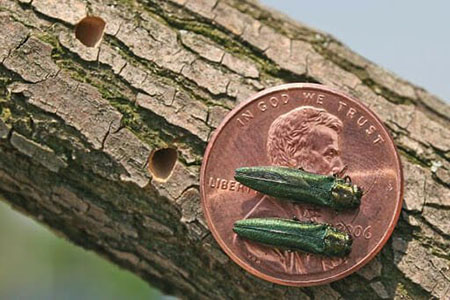
In the field
What Does It Affect?
- Green ash
- White ash
- Purple ash
- Autumn Purple ash
- All Fraxinus species
What Should I Look For?
- Distinctive D-shaped exit holes in the bark of infested trees.
- Canopy thinning and dieback that starts in the upper crown.
- Increased woodpecker activity on the trunk and scaffold limbs.
- Epicormic sprouting along the trunk and lower limbs.
Life Cycle & Development
- Adult beetles are metallic green and about 1/2 inch long.
- The insect has a high reproductive rate and spreads rapidly — adults disperse up to 2 miles on their own and up to 75 miles via human-assisted transport such as firewood or nursery stock.
What Does It Mean In Colorado?
In Colorado, EAB was first detected in 2013 in Boulder County, likely introduced via infested nursery stock. It has since spread to several other counties, including Denver, Adams and Jefferson, threatening Colorado's estimated 1.3 billion ash trees.
As populations of the insect continue to grow year after year, ash trees across the state will begin to die if left untreated.
As of 2021 EAB had been detected in 35 states and two Canadian provinces, infesting millions of ash trees and causing billions of dollars in damages.
Seasonal Timing
Spring
Larvae complete development beneath the bark; treatment planning should already be in place.
Early summer
Adult emergence and the appearance of D-shaped exit holes.
Any season
Ash inventory and candidacy evaluation — the decision homeowners actually control.
What Can Be Done?
01
Preventive treatment
Treatments need to be applied every two years, indefinitely into the future. Protecting a healthy ash is far more reliable than reacting after decline begins.
02
Candidacy evaluation
Not all ash trees are good candidates. Significant structural defects, small trees under 10 inches in diameter, trees near or under power lines, substantial stress from other pests, or existing infestation with more than 30% canopy decline all argue against treatment.
03
Cost vs. benefit planning
Long-term, the owner of the tree needs to consider cost versus benefit. Investing in treatment options to protect ash trees can be costly over time.
Prevention
- Identify whether you actually have ash on the property — many homeowners enjoy the shade without ever knowing the species.
- Do not move firewood; human-assisted transport is how EAB covers distance.
- Plan replacement plantings in advance for ash that will not be treated.
When Should I Call An Arborist?
- You have ash trees and no treatment program in place.
- You are unsure whether a tree is ash.
- Canopy thinning, woodpecker damage or D-shaped holes are already visible.
Related Services
Not sure what you're looking at?
Diagnosis is the difference between treating a problem and guessing at one. A Great Western arborist can identify what is affecting your tree before anything is applied.